What is autoclave treatment or pressure impregnation ?
The preservative (odorless and water-based) is injected under pressure (approximately 8 bars) into the wood. This provides long-lasting protection against rot and attacks from wood-boring insects.
When and why is autoclave treatment used?
This process is recommended for native softwoods (fir, spruce, pine, etc.), which are not sufficiently resistant to attacks from rot, fungi, and wood-boring insects. It is used for wood in contact with the ground or moisture, such as posts, terraces, avalanche barriers, stabilization structures, utility poles, playgrounds, bridges, structures on shorelines, balconies, etc. (Class 3: not in contact with the ground, for example, facades, noise barriers, visual screening walls).
What are the advantages of autoclave treatment?
Autoclave-treated wood has a lifespan three times longer than that of untreated softwood.
What color is the autoclave treatment?
After oxidation and fixing, the wood takes on a slightly green to brown color. The brown tint is obtained by adding a coloring paste. This is not an opaque coating, but a stain with limited penetration. The color after impregnation depends on the drying process, the surface structure, the depth of penetration of the product, and the quality of the wood.
What products are used ?
Tanalith C (Lonza Group Ltd.)
Korasit CX (Kurt Obermeier GmbH & Co. KG)
Wolmanit CX-10 (Dr. Wolman GmbH, BASF Group)
How should pressure-impregnated products be stored?
Impregnated wood must be stored away from rain and dirt and well ventilated.
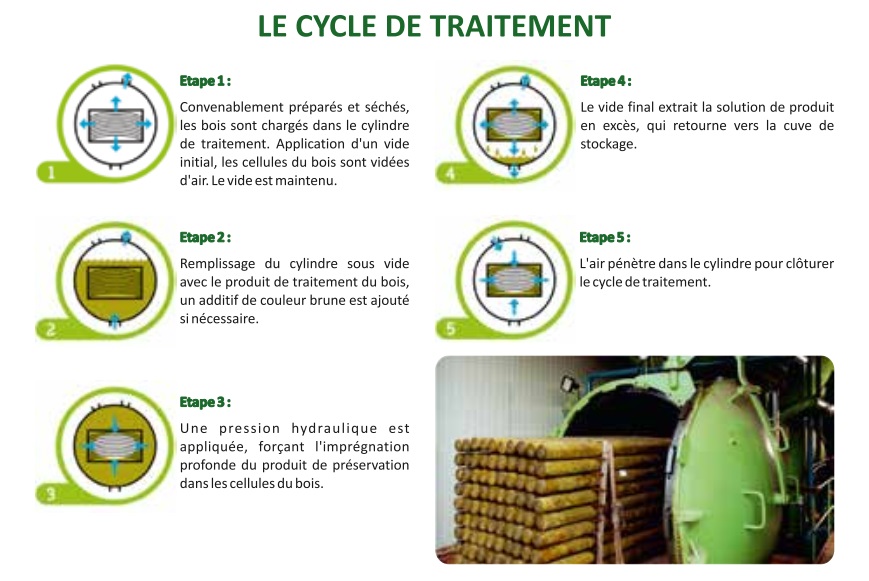
What are the phases of the treatment cycle?
- Step 1:
Properly prepared and dried, the wood is loaded into the treatment cylinder. Following the application of an initial vacuum, the wood cells are emptied of air. The vacuum is then maintained. - Step 2:
Fill the vacuum cylinder with the wood treatment product. A brown colour additive is added if necessary. - Step 3:
Hydraulic pressure is applied, forcing deep impregnation of the preservative product into the wood cells. - Step 4:
The final vacuum extracts the excess product solution, which is returned to the storage tank. - Step 5:
Air enters the cylinder to close the treatment cycle.