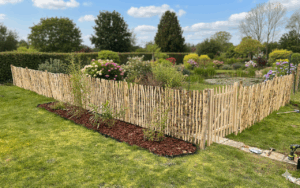
A paling fence (ganivelle) goes up quickly and without heavy tools – provided you follow a few rules that make all the difference between a fence that lasts ten years and one that sags after the first winter. Here is the method we pass on to landscapers and public authorities.
Equipment needed
- Rolls of paling fence at the height of the project
- Acacia stakes – one every 2 to 3 metres
- Galvanised tension wire (two rows: top and bottom)
- Staples or ties, tensioners, sledgehammer or post driver
- Optional: matching hazel gate
Installation in 5 steps
- Mark out the line: string line stretched between the ends, stakes marked every 2 to 3 m.
- Drive in the stakes: driven in to about one third of their length, point in the ground, aligned with the string. In loose soil or windy areas, reduce the spacing.
- Tension the wires: one galvanised wire at the top, one at the bottom, tensioned between the end stakes (braced with struts if the line is long).
- Unroll the paling fence: the roll is unrolled along the wires, with the vertical slats against the stakes.
- Fix it: tie the paling fence to the wires and stakes, tensioning regularly to avoid sagging.
Special cases
Coast and dunes
This is where the paling fence originated: close 5 cm spacing to filter the wind and hold the sand, 1.00 m height as standard. Acacia stakes are essential here – abrasive sand and sea spray quickly destroy treated wood. Our comparison of species explains why.
Windy areas
Reduce the stake spacing (2 m maximum) and choose the 5 cm spacing: it breaks the wind without acting as a sail, whereas a solid screen would take the full force.
Sloping ground
Install in steps (successive levels) rather than following the slope: each section stays vertical and the wire tension is easier to maintain.
Maintenance and service life
A hazel paling fence needs no maintenance: the wood turns grey naturally. Allow 5 to 8 years for the woven part; the acacia stakes last 20 to 25 years in the ground – you replace the roll, never the framework (see service life of an acacia stake).
Frequently asked questions
Should the stakes be set in concrete?
No – driving them directly into the ground is enough in the vast majority of cases, and it lets the wood breathe. Concrete traps moisture at ground level and speeds up rot. Reserve it for heavily loaded corner stakes, with a capillary break.
How many stakes should I plan for?
Divide the length by the chosen spacing (2 to 3 m) and add the end and corner stakes. Example: 100 m at 2.5 m spacing ≈ 41 stakes + bracing.
Do you deliver paling fences and stakes together?
Yes: rolls, acacia stakes, galvanised wire and gates travel on the same full truck – one transport, one quotation.
Price your project: send us the length, height and exposure, and we will reply with a professional quotation within 3 days.